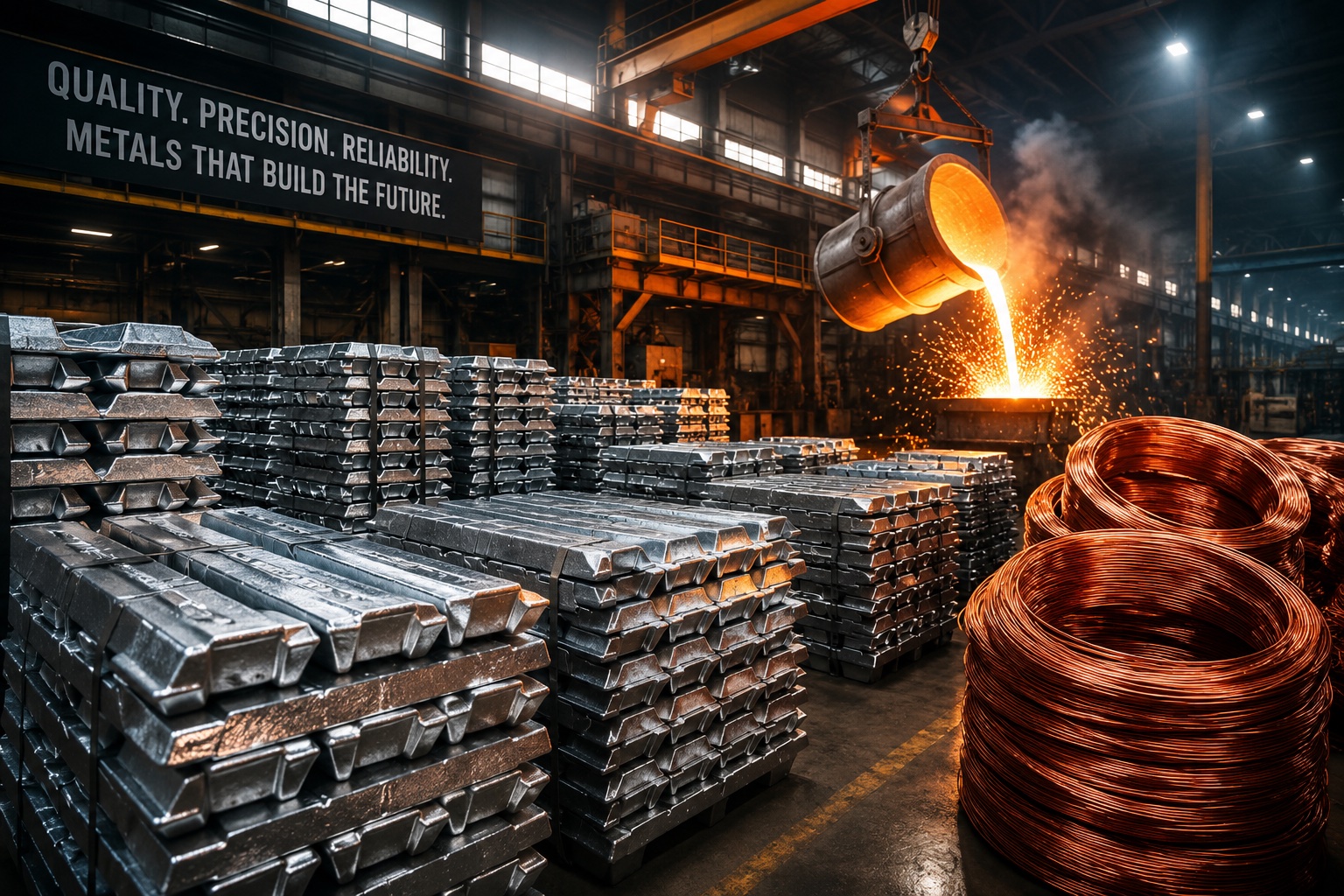
Every cable plant runs on the same feedstock: 8 mm copper wire rod. It is the standard input diameter for rod breakdown machines worldwide, and its purity decides how the next thousand hours of production run. Rod at 99.90% copper conducts, draws, and breaks differently than rod at 98.00%.
This guide covers the four standard copper wire rod grades, what each purity level means for conductivity, drawability, and breaks per ton, and how to pick the grade your product actually needs.
What purity controls in practice
Conductivity
Copper conductivity is rated against the IACS standard, where 100% IACS equals 58.0 MS/m at 20 degrees Celsius. Impurity atoms dissolved in the copper lattice scatter electrons and cut conductivity. Phosphorus, iron, and arsenic are among the worst offenders, and fractions of a percent produce measurable losses. This matters because cable designs are engineered against a maximum resistance per kilometre. If the rod conducts less, you compensate with a larger conductor cross-section. On high-volume production, that shortfall becomes a raw material cost line, not a rounding error.
Drawability
An 8mm copper wire rod is drawn down in stages: breakdown drawing to around 2 mm, then intermediate and multiwire drawing to fine gauges. Total reduction in cross-sectional area routinely exceeds 99%. The rod must survive that deformation without tearing at defects or work-hardening unevenly between anneals. Impurities segregate to grain boundaries, and oxide inclusions act as stress risers. Higher-purity rod anneals predictably and tolerates aggressive drawing schedules with fewer surface defects.
Breaks per ton
Breaks per ton is the number drawing operations actually manage. Every break stops the line. The operator rethreads or welds the wire, scraps the tangle, and restarts. At fine gauges, one hard inclusion in the rod is enough to snap the wire. Break frequency tracks rod cleanliness, so a cheaper rod that doubles your break rate costs more per finished ton than it saved at purchase. At fine gauges, rod quality effectively is your break rate.
Copper wire rod grades compared
MMA supplies high-purity copper wire rod, 8 mm diameter, export quality, in four grades.
| Grade | Minimum copper content | Primary application |
|---|---|---|
| Grade A | 99.90% | Electrical cable manufacturing |
| Grade B | 99.50% | Electrical industry |
| Grade C | 98.50% | Red copper product manufacturing |
| Grade D | 98.00% | General industrial applications |
Grade A is the cable maker's grade: maximum conductivity and the cleanest drawing behaviour. Grade B serves the broader electrical industry, where sections are heavier and reductions moderate. Grades C and D trade conductivity for cost in products where copper earns its place through formability, corrosion resistance, and thermal performance rather than a resistance spec.
When 99.90% is worth it and when 99.50% does the job
Specify Grade A at 99.90% minimum copper when:
- You draw to fine gauges or run multiwire lines, where each break costs the most
- The finished conductor must hit a defined resistance class per kilometre
- You produce feedstock for enamelled or magnet wire, where surface quality is critical
- Line speeds are high and downtime dominates cost. Fast lines lose more to breaks than they save on rod discounts
Grade B at 99.50% minimum does the job when:
- Final gauges are heavier and total reduction is moderate
- The product is general electrical hardware rather than a certified conductor
- The design carries enough conductivity margin to absorb the difference
Grades C and D belong in red copper products and general industrial work: fittings, forged parts, and components where 98.00% to 98.50% copper performs and price per ton decides. The rule is symmetrical. Do not pay for conductivity you will not use, and do not save on purity your drawing line cannot tolerate.
Choosing a copper wire rod supplier you can verify
The grade on the certificate only matters if it matches the metal in the coil. MMA is an Egyptian company specializing in metal sourcing, quality assurance, and international export. We don't just supply metals. We source, verify, and deliver according to your specifications.
Customers purchase directly from MMA. We manage supplier selection, production planning, quality verification, export documentation, and international logistics. Every shipment undergoes quality verification before export: representative samples are inspected to confirm compliance with customer specifications, chemical composition is confirmed, and only approved products proceed to export.
Rod ships in steel coil packing with export standard packaging and container loading. If your specification falls outside the four standard grades, MMA manufactures rods and ingots to the customer's required chemical composition and technical specifications. Alongside copper, we export recycled aluminum ingots in four grades for conductor and casting applications.
Send your target grade, gauge range, and monthly volume to sales@mmametal.com. We target a 48-hour quote turnaround. To get pricing on your next order, request a quote.