Most procurement teams scanning for new metal supply origins check the same familiar markets. Egypt rarely makes the shortlist. That is a gap worth closing. The country combines a large manufacturing base, mature recycling streams, and a logistics position built around the Suez Canal. This article sets out the case for metal sourcing from Egypt, and explains how a sourcing partner model removes the main risks of buying from mills you have never audited.
Why Egypt is a strategic metal sourcing origin
A manufacturing base built on real domestic demand
Egypt runs one of the largest industrial economies in Africa and the Middle East. Its cable, construction, automotive, and cookware sectors consume aluminum and copper at scale, every day. That demand has built a network of smelters, foundries, and rod mills with genuine production depth. When you source metal from Egypt, you are buying from producers that already serve demanding local industries, not from operations assembled purely for export.
Recycling streams that feed secondary production
Egypt has a mature scrap collection and recycling sector. Aluminum and copper scrap moves through established channels into secondary smelting and refining. The result is consistent feedstock for products such as recycled aluminum ingots in defined purity grades, from 99.0% minimum aluminum for electrical applications down to automotive alloys. For buyers with emissions reporting obligations, recycled input is an advantage, not a compromise.
Logistics: Suez, the Mediterranean, and the Red Sea
Geography is Egypt's structural edge. The Suez Canal runs through the country. Container ports sit on both the Mediterranean and the Red Sea, so cargo can load for Europe from the north coast or for Asia and the Gulf from Red Sea terminals, without repositioning production. Few origins offer short transit times to Europe, the Gulf, and Asia from the same industrial base.
The risk of buying direct from unknown mills
Buying direct from a mill you found online looks cheaper on paper. In practice it concentrates risk on the buyer:
- Capability risk. You cannot verify production capacity, equipment, or quality systems from a brochure.
- Specification risk. A certificate of analysis is a claim. Until someone independent checks the material, chemical composition is unconfirmed.
- Documentation risk. Export paperwork errors stall customs clearance and tie up working capital in port.
- Accountability risk. If a shipment arrives off-spec, a single-transaction mill has little incentive to make it right.
Each of these risks is manageable. Managing them requires people on the ground, at the mill, before and during production. Most international buyers do not have that presence in Egypt. A sourcing partner does.
The sourcing partner model: one accountable company
MMA is an Egyptian company specializing in metal sourcing, quality assurance, and international export. The model is simple. Customers purchase directly from MMA, and MMA manages the supplier network behind the order. Instead of vetting mills yourself, you contract with one metal supplier in Egypt that carries responsibility for the full chain. The positioning is deliberate: "We don't just supply metals. We source, verify, and deliver according to your specifications."
Every order moves through seven controlled stages:
- Selecting the manufacturing partner
- Production planning
- Monitoring manufacturing progress
- Verifying product quality
- Confirming chemical composition
- Export documentation
- International logistics
Quality is not a final-gate formality. Every shipment undergoes quality verification before export. Representative samples are inspected to confirm compliance with customer specifications before shipment approval, and only approved products proceed to export. If the material does not meet your specification, it does not ship.
What you can source through MMA
Recycled aluminum ingots
MMA supplies high-quality recycled aluminum ingots in four grades:
- Grade A, 99.0% minimum Al, for electrical conductors & the cable industry
- Grade B, 98.0% minimum Al, for aluminum profiles, cookware & industrial applications
- Grade C, 97.0% minimum Al, for foundries & general casting
- Automotive Alloy, 84-85% Al, for automotive components & industrial castings
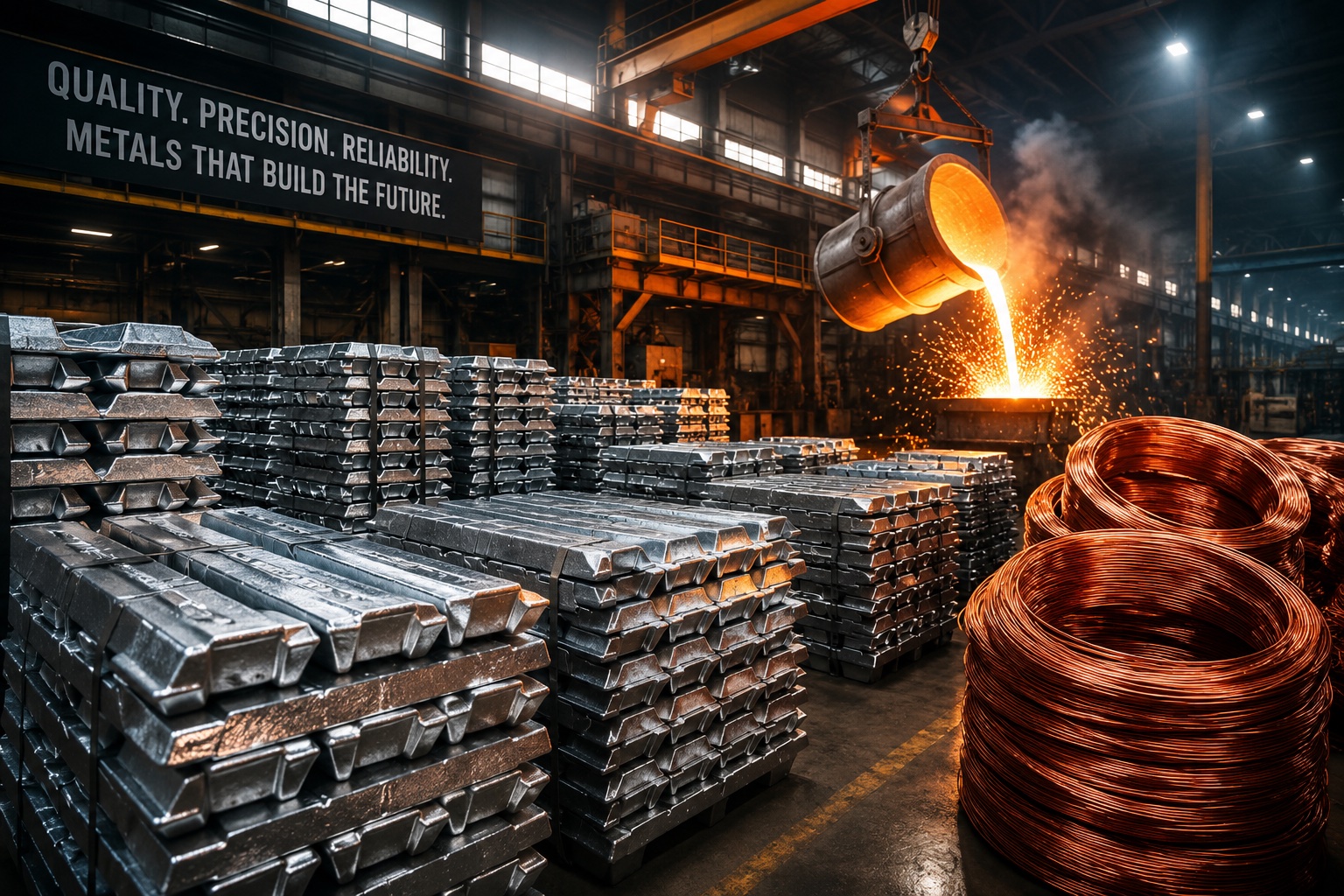
Ingots ship in steel-strapped bundles with export standard packaging and container loading. Custom packaging is available on request.
Copper wire rod
MMA supplies high-purity 8 mm copper wire rod at export quality in four grades:
- Grade A, 99.90% minimum Cu, for electrical cable manufacturing
- Grade B, 99.50% minimum Cu, for the electrical industry
- Grade C, 98.50% minimum Cu, for red copper product manufacturing
- Grade D, 98.00% minimum Cu, for general industrial applications
Rod ships in steel coil packing with export standard packaging and container loading.
Custom manufacturing
Standard grades do not fit every application. MMA also arranges ingots and rods manufactured to the customer's required chemical composition and technical specifications, produced through the same seven-stage process and the same pre-shipment verification.
Egypt has the industrial base, the recycled feedstock, and the port position. What most buyers lack is a counterparty they can hold accountable. That is the function of a sourcing partner in Egypt: one contract, one quality standard, one company answerable for what lands at your port. Send your specification to sales@mmametal.com with a quote turnaround target of 48 hours, or request a quote.