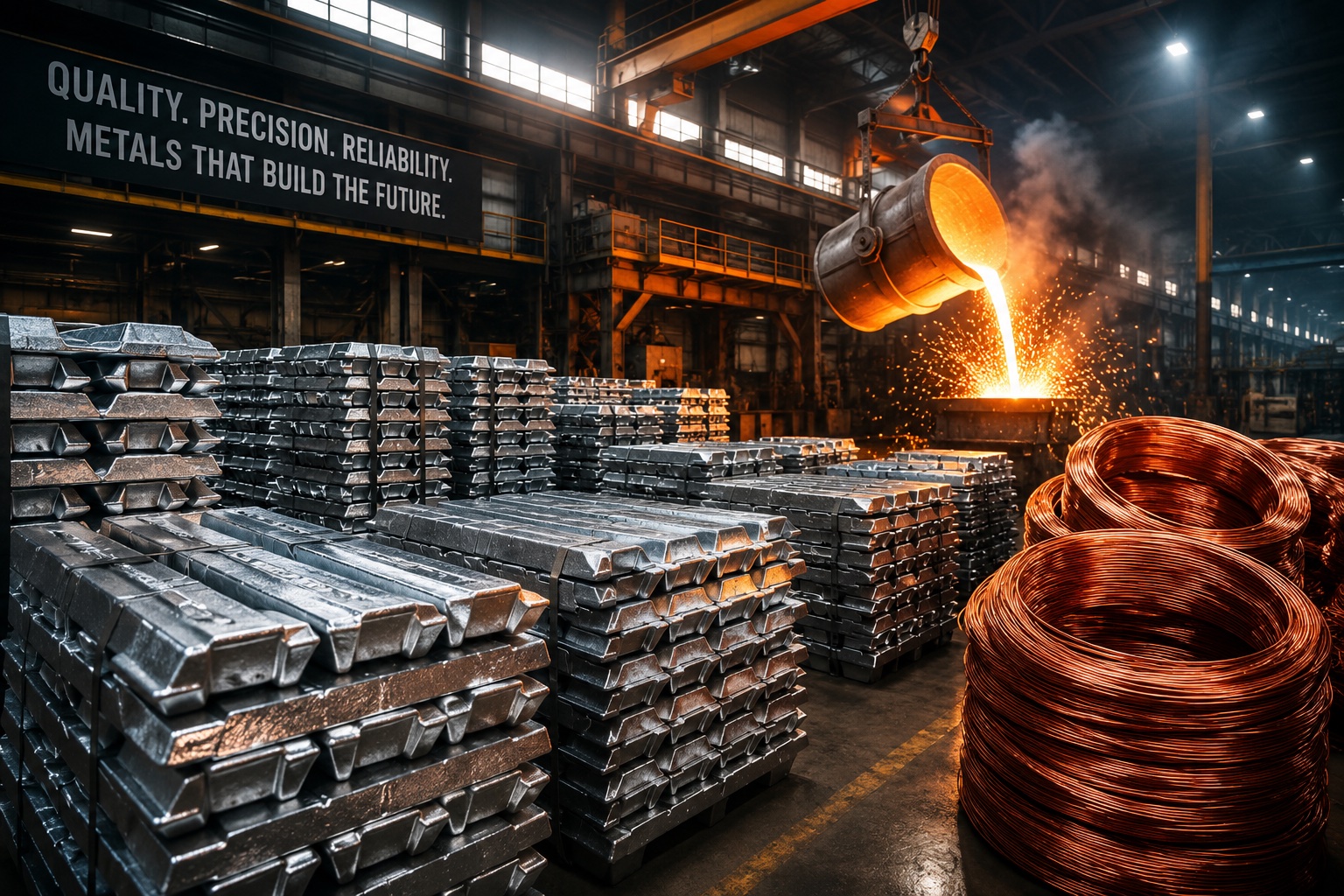
Buying recycled aluminum ingots from Egypt comes down to three questions. Which grade does your process need? Can the supplier hold that chemistry shipment after shipment? And who verifies the metal before the container leaves port? This guide answers all three.
MMA is an Egyptian company specializing in metal sourcing, quality assurance, and international export. Buyers purchase directly from MMA, and MMA manages supplier selection, production planning, quality verification, export documentation, and international logistics. The principle is simple: we don't just supply metals. We source, verify, and deliver according to your specifications.
Aluminum ingot grades: what the numbers mean
Aluminum ingot grades are defined by minimum aluminum content. A higher percentage means fewer impurities such as iron, silicon, and zinc, and those impurity levels decide what the ingot can safely become. MMA supplies four grades of recycled aluminum ingots, each matched to a distinct set of applications.
| Grade | Minimum aluminum content | Typical applications |
|---|---|---|
| Grade A | 99.0% min Al | Electrical conductors & cable industry |
| Grade B | 98.0% min Al | Aluminum profiles, cookware & industrial applications |
| Grade C | 97.0% min Al | Foundries & general casting |
| Automotive Alloy | 84-85% Al | Automotive components & industrial castings |
Grade A: 99.0% minimum aluminum
The tightest specification in the range. Electrical conductivity drops as impurity content rises, so conductor and cable manufacturers need metal at 99.0% or better. If you draw wire, strand conductors, or produce cable, this is your grade.
Grade B: 98.0% minimum aluminum
The workhorse. At 98.0% minimum aluminum, Grade B extrudes cleanly and finishes well, which makes it the standard choice for aluminum profiles, cookware, and a wide band of industrial applications. Most buyers without a conductivity requirement land here.
Grade C: 97.0% minimum aluminum
Built for the melt shop. Foundries and general casting operations remelt Grade C and adjust chemistry in-house, so paying for higher purity adds cost without adding value. If the ingot goes straight back into a furnace, Grade C is usually the economical answer.
Automotive alloy: 84-85% aluminum
This is not a lower-quality ingot. It is a deliberate alloy, with 84-85% aluminum plus alloying elements that deliver the castability and strength automotive components demand. Die casters producing automotive parts and industrial castings order it as ready-to-melt feedstock instead of alloying up from pure ingot.
Why recycled ingots with stable chemistry are a smart buy
Aluminum recycles without losing its metallurgical properties. Remelting scrap into ingots consumes far less energy than primary smelting, and that gap shows up directly in your landed cost. It also cuts the embodied carbon of your product, which more end customers now audit.
The catch with recycled metal is variability. Scrap streams differ, and an ingot lot that drifts off specification means correction alloying, scrapped heats, or rejected parts. Stable chemistry, not just a grade label, is the real purchasing criterion. Ask any prospective aluminum ingot supplier in Egypt two things: how each batch is tested, and how batch-to-batch consistency is controlled.
MMA answers both with process. Every shipment undergoes quality verification before export. Representative samples are inspected to confirm compliance with customer specifications before shipment approval, and only approved products proceed to export. For buyers with non-standard requirements, MMA also arranges custom manufacturing: ingots produced to your required chemical composition and technical specifications.
What to check before importing from Egypt
Before you sign a contract for recycled aluminum ingots from Egypt, work through this list.
- Confirm the grade against your application. Order Grade A for conductors, Grade B for profiles and cookware, Grade C for remelt, and Automotive Alloy for die-cast components. Overspecifying purity wastes money. Underspecifying creates rejects.
- Demand chemical analysis for every lot, not a generic datasheet. The certificate should state minimum aluminum content and the impurity levels that matter to your process.
- Verify pre-shipment inspection. Samples should be tested and approved against your specification before loading, not after arrival.
- Check the packaging specification. MMA ships in export-standard, steel-strapped bundles with container loading, and custom packaging is available on request. Poorly bundled ingots shift in transit and arrive damaged.
- Review export documentation early. Analysis certificates, packing lists, and origin documents should be prepared by the exporter, with customs classification confirmed for your destination.
- Clarify logistics responsibility. Agree who books the container, which Incoterms apply, and how transit is tracked.
How MMA manages the supply
MMA runs a seven-stage supply process: selecting the manufacturing partner, production planning, monitoring manufacturing progress, verifying product quality, confirming chemical composition, export documentation, and international logistics. You place one order and get one accountable counterparty for all seven stages.
The same model covers copper. Alongside aluminum, MMA exports high-purity 8 mm copper wire rod in four grades, from 99.90% minimum copper for electrical cable manufacturing down to 98.00% for general industrial applications. Buyers sourcing both metals consolidate quality assurance and logistics under one supplier.
If you are evaluating an aluminum ingot supplier in Egypt, start with a specification, not a price list. Send your target grade, chemistry limits, monthly volume, and destination port to sales@mmametal.com. MMA targets a quote turnaround of 48 hours. Put your specification in front of us and request a quote.